Backyard races are much more than an endurance challenge: they are an experience where every participant pushes their own limits, lap after lap. With no fixed finish line and no maximum time, the goal is as simple as it is demanding: to start again every hour for as long as body and mind allow.
The format is simple: 6.706 km, one start every hour, and 60 minutes to complete each lap. Finish the lap, rest for whatever time you have left, and when the bell rings again, a new lap begins.
Simple to understand, hard to walk away from.
Backyard Ultra seems simple: one lap, one hour, then start all over again. But that is exactly what makes it so tough. The winner isn’t the fastest runner, but the one who can go out for one more lap when body and mind start telling them to stop.
Every hour, the bell rings. Every hour, a new decision begins.
Here, the fastest runner doesn’t win. The winner is the one who manages to go out for one more lap.
The Origins of Backyard Ultra
Big Dog’s Backyard Ultra was created by Gary “Lazarus Lake” Cantrell, who also created the legendary Barkley Marathons, in Tennessee, United States. The principle behind the format is as simple as it is demanding: complete a 6.706 km loop every hour.
Why 6.706 km?
The distance is no coincidence. At 6.706 km per lap, completing 24 laps in 24 hours adds up to 100 miles: 160.9 km.
This is how one of the defining features of Backyard Ultra was born: one lap every hour, 24 hours, 100 miles.
But reaching 24 laps doesn’t mean the race is over. If you can return to the start when the next hour begins, the Backyard continues.
How long is a Backyard?
In a Backyard Ultra, there is no set final distance, fixed finish line or maximum time limit. The race can last a few hours, go beyond 100 miles, or continue for several days.
The limit isn’t set by the distance: it’s set by the last person able to go out for one more lap.
There is no finish line. There is a decision to make every hour.
The race continues for as long as there are participants able to complete the lap within the time limit and return to the starting corral.
Only one person completes the final lap alone. Everyone else, whether they completed 4, 7, 24 or many more laps, becomes part of the history of the race.
The Base Camp: Where the Race Continues
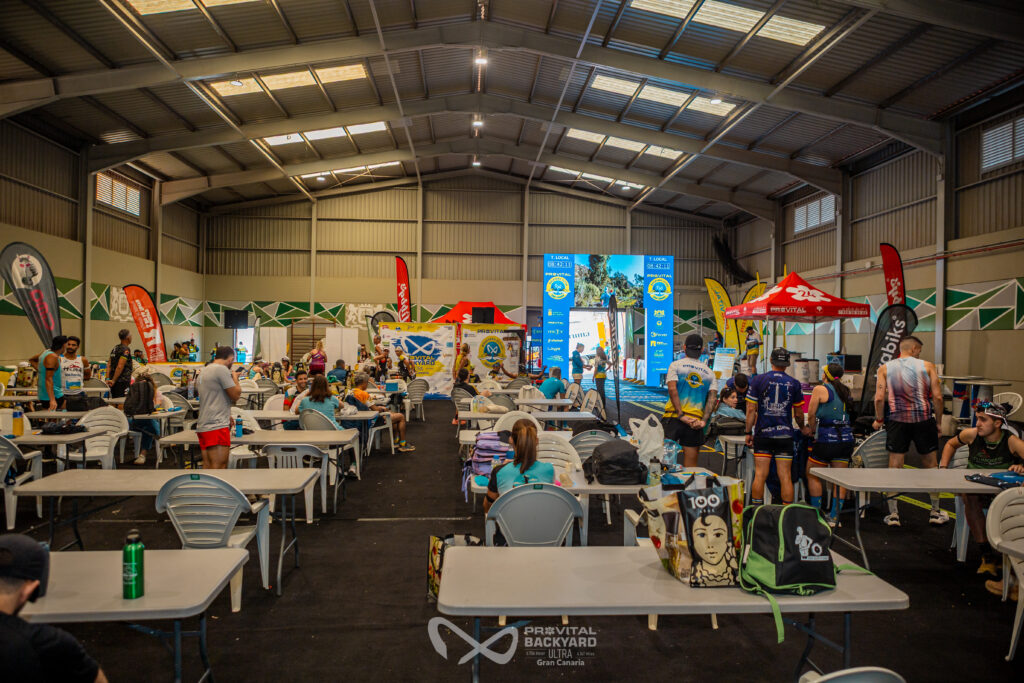
Backyard Ultra isn’t just experienced out on the course. It also comes alive at the base camp: the place where runners, crews, families, volunteers and organisers share hours of effort, anticipation, nerves, rest and emotion.
It’s where every lap ends… and where the next one begins.
THE BASIC RULES OF A BACKYARD ULTRA
The magic of Backyard lies in its simplicity. These are the main rules:
1. COURSE
It may be a closed loop or an out-and-back course.
It must measure 4 miles and 880 feet, equivalent to 6.706 km.
2. STARTING CORRAL
It must have enough capacity for all participants.
It remains the same size throughout the race.
To remain in the race, participants must be inside the corral when the bell rings.
3. STARTS
Each new lap begins exactly one hour after the previous one.
Warnings are given with 3, 2 and 1 minute remaining before the start.
Everyone must start at the sound of the bell. Late starts are not allowed.
4. LAPS
Once a lap has started, participants may not leave the course until it is completed, except to use the toilet.
No non-competing person may accompany the runners, including participants who have already been eliminated.
Personal assistance is not allowed during the lap. Common aid stations may be provided.
Each lap must be completed in under one hour, including the final lap.
Artificial aids are not permitted, including trekking poles.
Slower runners must allow faster runners to pass.
5. TIMING
Recording each participant’s individual lap time is optional.
6. WINNER AND RESULTS
The winner is the last person to successfully complete a lap.
Technically, all other participants are recorded as DNF.
Results must show the distance/laps completed by each participant.
If no one manages to complete one more lap than the rest, the race ends without a winner.
7. NO LIMIT
A Backyard Ultra must be an open-ended event, with no predetermined maximum number of laps.
Source: Official Big’s Backyard Ultra Rules
More Than a Race: The Backyard Spirit
A Backyard cannot be understood through its rules alone. You have to experience it. As the hours pass, the challenge stops being purely physical: fatigue sets in, doubts creep in, night falls, and the same question returns after every lap: do I go out one more time?
Here, speed takes a back seat. What matters is consistency, strategy and the ability to keep going. And while runners remain in the race, something happens that is hard to find in other events: people competing against each other, yet helping one another to keep going for hours.
Reasons to Run a Backyard:
Because you can go much farther than you imagine. The controlled pace, the rest between laps and the ability to manage your race hour by hour mean that many participants reach distances they have never covered before.
Because every lap is a new challenge. You don’t need to think about 50, 100 or 160 kilometres. Your goal is always the same: complete 6.706 km and be ready to go again.
Because your mind matters just as much as your legs. As the hours pass, you’ll have to manage fatigue, nutrition, rest and doubt.
Because a Backyard is experienced in a different way. Between laps, a very special atmosphere develops among runners, crews, organisers and volunteers.
Because in a Backyard, you never really know where your limit is until you decide to look for it.
Now that you know how it works, the next lap is up to you.
Para ofrecer las mejores experiencias, utilizamos tecnologías como las cookies para almacenar y/o acceder a la información del dispositivo. El consentimiento de estas tecnologías nos permitirá procesar datos como el comportamiento de navegación o las identificaciones únicas en este sitio. No consentir o retirar el consentimiento, puede afectar negativamente a ciertas características y funciones.
Funcional
Always active
El almacenamiento o acceso técnico es estrictamente necesario para el propósito legítimo de permitir el uso de un servicio específico explícitamente solicitado por el abonado o usuario, o con el único propósito de llevar a cabo la transmisión de una comunicación a través de una red de comunicaciones electrónicas.
Preferencias
El almacenamiento o acceso técnico es necesario para la finalidad legítima de almacenar preferencias no solicitadas por el abonado o usuario.
Estadísticas
El almacenamiento o acceso técnico que es utilizado exclusivamente con fines estadísticos.El almacenamiento o acceso técnico que se utiliza exclusivamente con fines estadísticos anónimos. Sin un requerimiento, el cumplimiento voluntario por parte de tu proveedor de servicios de Internet, o los registros adicionales de un tercero, la información almacenada o recuperada sólo para este propósito no se puede utilizar para identificarte.
Marketing
El almacenamiento o acceso técnico es necesario para crear perfiles de usuario para enviar publicidad, o para rastrear al usuario en una web o en varias web con fines de marketing similares.